



How can you ensure that the center of gravity distribution of a folding hair dryer does not affect the grip when it is folded in different ways?
Release Time : 2026-03-03
When designing a folding hair dryer, special attention must be paid to the impact of weight distribution on the grip in different folded states to ensure a stable and comfortable grip experience for users regardless of the folding configuration. Achieving this goal relies on meticulous optimization of the hair dryer's internal structure, material distribution, and folding mechanism.
In the design of a folding hair dryer, the placement of the motor and battery is a key factor affecting the weight distribution. The motor, as the core power source, is typically positioned near the center of the handle to balance the overall weight. The battery usually employs a symmetrical design, distributed on either side of the motor or below the handle. By precisely calculating the battery pack's center of gravity, it is ensured that, in the folded state, the combined force of the battery and motor is as close to the handle as possible, reducing wrist strain. For example, some high-end folding hair dryers use a dual-battery pack design, optimizing the angle and position of the battery packs to maintain overall stability even when folded, avoiding a top-heavy feel.
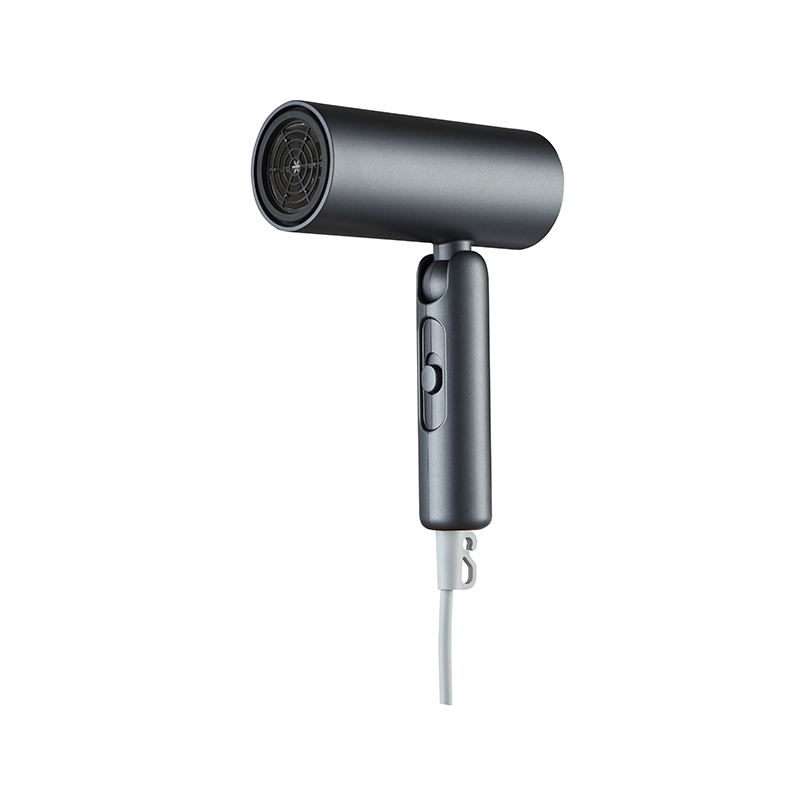
Innovative folding structure design is another important means of ensuring a reasonable weight distribution. Traditional folding hair dryers often use a single-axis folding method, which can easily lead to loosening of the folded parts due to wear and tear after prolonged use, thus affecting the stability of the center of gravity. Modern folding hair dryers, however, incorporate multi-axis or flexible folding technologies. By increasing the connection points and support structures at the folding points, they improve the stability of the folded state. For example, the Dreame Pocket P10 hair dryer uses a 0°-180° full-folding design. Through flexible folding technology, the body maintains structural stability at any angle. Combined with optimized internal airflow, this ensures that airflow output is not affected by the folding state, and the center of gravity distribution always conforms to ergonomic requirements.
The choice of materials and lightweight design also significantly impacts the center of gravity distribution. Folding hair dryers must balance portability with structural strength and weight balance. High-end models often use aerospace-grade aluminum alloy or high-strength plastic as the shell material. These materials are not only lightweight but also have good impact resistance and corrosion resistance, effectively reducing the overall weight and bringing the center of gravity closer to the handle. In addition, some hair dryers feature non-slip textures or skin-friendly materials on the handle to enhance grip and comfort, further mitigating discomfort caused by a shift in the center of gravity.
The application of ergonomic principles in the design of folding hair dryers further optimizes the holding experience. Designers simulate user grip postures in different folded states, adjusting the shape and size of various components to ensure that the handle's thickness, length, and button placement conform to the curve of the palm. For example, the Dyson Supersonic hair dryer's foldable handle design not only achieves an elegant geometric shape but also ensures a natural fit with the palm at different folding angles, reducing fatigue from prolonged use.
While intelligent temperature control and airflow optimization technologies don't directly affect the center of gravity distribution, they do contribute to improved grip comfort. By precisely controlling the airflow temperature and speed, they reduce damage to the scalp and hair from high temperatures, while also reducing vibration and noise during operation, providing users with a more stable and quiet operating experience. This comprehensive design consideration allows the folding hair dryer to meet portability needs while providing a user experience comparable to traditional hair dryers.
Ensuring that the center of gravity distribution doesn't affect the grip in different folded states requires attention to multiple aspects, including motor and battery layout, folding structure design, material selection, ergonomic application, and intelligent technology assistance. Through these meticulous design optimizations, the folding hair dryer not only achieves a perfect balance between portability and functionality but also provides users with a stable, comfortable, and efficient hair drying experience every time they use it.